
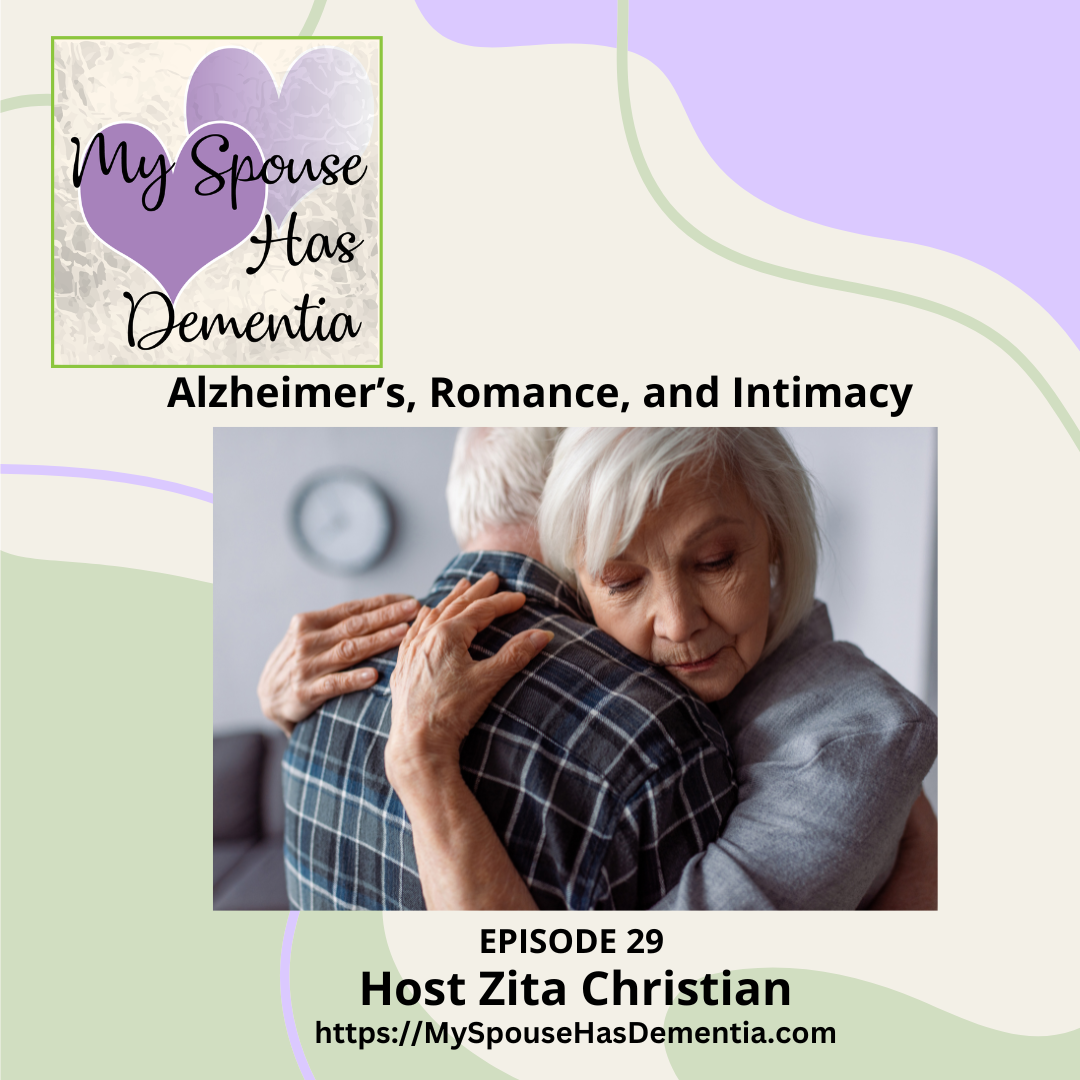
Alzheimer's, Romance, and Intimacy


You will never regret being kind to your spouse.
In a strong marriage, the sexual expression of love is the sinew that ties two hearts together and forms the kind of bond we depend on to get us through life's greatest challenges. As we age, the intensity of physical passion burns more ember than flame, but the bonds of love can be just as strong, even stronger, than ever.
Alzheimer's forces a wedge in the relationship. Caregiver stress is more devastating than you imagined. Frustration and Anger barge into your home and wreak havoc in your daily world. Anticipatory grief destroys your dream of the future.
Whether the dementia caregiving journey takes a few years or a decade or more, love doesn't fade from a strong marriage. The challenge is learning how to express that love in a new way.
After marrying more than 150 couples, publishing 3 historical romance novels with Harper Collins, and being married for 41 years to a man I loved deeply, I've learned some things about weddings, romance, intimacy, and dementia. I share a few of those thoughts in this episode.
Mentioned in the episode:
John van Gurp's YouTube channel: John and Heather's Dementia Journey
Be sure to listen to episode 28 about how using improv can help caregivers enter the world of their loved one. Let me know if you'd like to be part of an online improv class where all the participants are dementia family caregivers.
I'm working a future episode about how it feels to have to care for a family member with dementia when you would never refer to that person as your "loved one." If that's you, please contact me. Email: zita@myspousehasdementia.com
Are you caring for a spouse with dementia? Have you written a book about dementia? Please let me know. I'd love to speak with you. Send an email to: zita@myspousehasdementia.com
It's July 2025. The third anniversary of my husband's death is on the doorstep. We were married for 41 years and 8 days.
I find myself looking back through correspondence, journal entries, photographs, cards, and notes that I made in the margins of my cookbooks. All of those bring back memories. Time has shaped a vision of the future.
Memories don't bruise the way they once did, though song lyrics still bite, especially Anne Murray and Could I Have This Dance? Time has given me a perspective about dementia's effect on romance and intimacy.
That's what this episode, number 29, is all about. You're listening to My Spouse Has Dementia, proud to be shortlisted for the 2025 International Women's Podcast Awards.
On this podcast, I share personal stories, occasional interviews, and simple rituals to support dementia caregiving spouses, because the odds of our survival aren't very good. I'm Zita Christian, writer, lifecycle celebrant, widow.
My husband had Alzheimer's. Let me begin here with the obvious. People are different.
How Alzheimer's affected my husband won't mirror precisely how it is affecting your left one. At the same time, Alzheimer's does cause some changes that are pretty predictable. The same is true for caregivers.
You and I are different people. We've been shaped by different life experiences. We've developed different strengths.
We struggle with different weaknesses. At the same time, we both face sadness and anger, anxiety and determination, despair, for sure, and hope. Our identity as a caregiving spouse colors our experience in unique ways.
If you're like me, happily married for a long time, you've probably developed some comfortable routines and practical ways of sharing responsibilities. I'd cook. Dick would clean up.
I'd gather the trash. He'd take it outside. I'd fold the clean laundry, and he'd carry the basket up the stairs.
Whenever he fell asleep in his recliner, I covered him with a blanket. Whenever I came down the stairs with a basket of laundry to wash, he jumped out of that chair and took the basket from me. So much love in such little memories.
And then, of course, dementia muddles everything. We easily recognize some changes and take over routine tasks our spouse always handled, such as paying the bills, winding the grandfather clock, or filling the car with gas.
We don't have a hard time with those adjustments when the progression of the disease is slow. On the other hand, we might flounder with the totally unexpected. I'm thinking of a conversation I had with John van Gurp.
He's caring for his wife Heather. She has dementia. Before the disease took hold, she decorated their home with all sorts of pillows and blankets and curtains and towels.
Her mental decline was fast, leaving John emotionally blindsided by what he calls all the cloth things. You can follow John on his YouTube channel. It's called John and Heather's Dementia Journey.
You can also listen to my conversation with him in episode 26 of this podcast, when he talks about all the cloth things. As I mentioned at the beginning, I want to talk about romance in this episode.
Back in the mid-90s, I worked full time as a romance writer, having three historical novels published by Harper Collins. More recently, I worked for about ten years bringing Happily Ever After to life as a wedding officiant.
I've married more than 150 couples, customizing ceremonies with the magic of herbs, the mythology of trees, the beauty of moths, the history of keys, the Celtic legend of nine waves. The lore of maritime knots for a ceremony at a historic seaport.
And messages from crows in a goth Viking ceremony held on the grounds of a haunted mansion.
I would often spend a year or more getting to know my couples so that I could create a meaningful personal ritual for the ceremony, and so that I could write their love story.
Sharing not only how they fell in love, but why made their story a central part of the ceremony.
Through writing romance novels and the love stories that anchored my wedding ceremonies, I've learned a few things about what attracts one person to another, and about what keeps most of them together.
What I've seen is that when two people meet and are attracted to each other, each one is checking off items on the list called my type. Before the popularity of dating apps, people placed personal ads in the classified section of a newspaper.
I remember reading them, thinking that I might find something I could use in creating a character for one of my books.
Unfortunately, the majority of the ads, you know, said some version of the same thing, like, I like dining out, sitting by a fire, and taking long walks on the beach. I never saw an ad that said: I don't cook, and I have no desire to learn.
I hope you like takeout. And I never saw an ad that said: I have massive credit card debt. I hope you have a lot of money.
Yes, I am exaggerating, but not entirely. See, in those early stages of dating, people often keep some things hidden. Of course, couples do find each other.
At first, they share a physical attraction. Then they discover shared interests. And for some, they share the same dreams.
Maybe that's to travel, or buy a house, raise a family, or maybe what they both want is to make the world a better place. With those shared dreams, their relationship grows and deepens. Because now they know for sure that they also share values.
They share trust. And trust opens the door to love. In fact, I don't think love can survive without trust.
And I think it's a lot easier to trust someone if you share the same values. Then comes that moment in the relationship when these two people can't imagine life without the other.
Now, they may have been physically intimate all along, but what they feel now is a deep, deep need to commit.
Whether or not a couple crosses the legal threshold of marriage, the bond created by shared values, trust and love, assumes that each person sees the sexually intimate part of their relationship as both sacred and exclusive.
Over time, couples in love often create their own language and it might not include words. You know what I mean, a certain kind of smile, a tilt of the head, an extended hand. That private prelude and the physical and emotional closeness it promises.
Think of it as the sexual sinew that ties two hearts together and forms the kind of bond we depend on to get us through the most challenging times. We willingly, eagerly, become physically vulnerable to the other.
We trust each other with our hearts and our bodies in a way we don't trust anyone else. As we age, the intensity of passion often burns more ember than flame. At the same time, love solidifies and deepens.
Tested by all sorts of challenges, the bonds of love hold fast. If we've been building them all along, and if we're lucky, no matter how strong those bonds, when dementia enters the picture, stress can fray them.
It becomes clear that the future we dreamed of sharing is not what's in store. The vibrancy fueled by hope fades. How can it not?
Dementia confuses, agitates, and destroys all those shared memories. And at the same time, caregiving frustrates, worries the mind, and exhausts the body.
As caregivers, we're so occupied with medicine and medical appointments, and laundry, and cooking, and feeding, and toileting, and making sure to avoid choking hazards, tripping hazards, wandering, and falling. We can't keep up with all the changes.
We get overwhelmed. Without sleep, which is common for caregivers, anger erupts from the shadows. Cracks erode the foundation built by those wedding vows.
Guilt stings. And before you know it, the sexual expression of love disappears.
Sadly, that day comes when we realize that the physical intimacy we shared with our spouse not only is a thing of the past, it has been a thing of the past for some time now. Fate has already cut that cord, and it cannot be restored.
And suddenly we scramble through our memories. When was the last time we made love? Was it rushed or was it beautiful?
I remember the last three times my husband and I made love, because each time I feared it would be the last. I didn't want to forget that exquisite closeness.
Whether we remember the last time or not, whether we feel sadness or relief, dementia has bleached us of something vivid and vital. Months go by without understanding why. We feel untethered, unsteady, set adrift.
We feel a whole new kind of lonely, and for some of us a growing fear. There were times when I imagined myself at the beach, standing on the shore, the waves washing over my toes. With each ebb and flow, my feet sink into the sand.
Deeper, deeper. And suddenly I realize my feet are not in sand, they're in cement. I can't move.
And on the horizon, heading straight for me is a tsunami. If you've imagined something similar, take a deep breath. Because that, my friend, is when trial transforms us.
That's when we can become the alchemist. Yes, we feel broken apart. Such destruction always comes from the heavy rites of passage: Death. Serious illness. Divorce.
Our loss of identity and feelings of hopelessness threaten to destroy us too. But our story isn't over. I remember taking deep breaths, imagining my lungs expanding, holding all the air I needed until the tsunami subsided.
I imagined the force of the waves dissolving the cement that locked my feet in place. I unsealed my fate. Think about this.
Does a caterpillar in a cocoon feel itself changing? I don't know. But I know we feel the process of change.
We know we are not the same. We are being reconstituted, reassembled, reimagined into a new version of ourselves to be defined over time. When you are the caregiving spouse in a strong marriage, you still feel love just as deeply as ever.
You just express it differently now. What's important is that you do express it. When the physical intimacy of marriage disappears, we can still experience closeness.
One way is to create a calm atmosphere. Here are three ideas that might help. I say might, because I can't guarantee anything.
I'm not an authority on relationships or dementia. I write from decades of writing romance novels, officiating weddings, and most importantly, from the lived experience of caring for my husband who died from Alzheimer's.
So first, play soothing music. I found an interesting article from 2012 on pbs.org. The article refers to a study conducted at University of California Irvine about the effects of music on the brain.
It talks about how people with Alzheimer's improved their memory when they listened to classical music. Other studies since then support that same conclusion. Number two, oh gosh, pay attention to what's on the television.
If you must have the television on, avoid news channels, avoid game shows that feature lights and bells and buzzers, avoid nature shows about predators, shows about baby animals, sure. Nature shows about the beauty of the planet, yes.
Cooking shows are okay too, as long as they aren't the competitive kind with frantic people running around swearing at each other. You see, a person with Alzheimer's could easily think that what's on the television is happening in the room.
I know that's how it was with Dick. I remember seeing him stand right in front of the screen. He was talking to the people on the news.
Long before I met Dick, he was a news director at a radio station in Fresno, California. I wondered if there was something about those television newscasts that felt familiar.
So I would always snuggle close to him, tuck my arm into his, and I would talk to the people on the screen too, just like he did.
The third thing you can do is notice the air in your home. If the weather is nice, open the windows.
If that's not a good option, consider diffusing essential oils. My home always smells like a blend of frankincense, palo santo, sandalwood, and vanilla. I diffuse those essential oils upstairs, downstairs, even in the basement.
I never use synthetic oils. Not so much because of the aroma, but because I want the true magic, the physiology of essential oils, not just the fragrance.
As any good aromatherapist or herbalist will tell you, essential oils, the properties of essential oils, have real effects on the body, including the brain.
Of course, an easy and tasty way to enhance the air in your home is to bake cookies or bread or make a flavorful soup or a hearty stew. Consider the products you use to clean your home.
Those scents can make you inhale and smile or wrinkle your nose and cringe. And of course, don't let garbage pile up, especially soiled, disposable undergarments. Romance and intimacy at whatever age involves being kind.
I love fairy tales, but I don't live in one. When dementia is part of the picture, caring for a spouse can be particularly frustrating.
When you're still in denial about the severity of the disease, anger can be a way to get a response from your spouse. Speaking for myself, if your spouse responds in a way that makes sense, well, then you know that things aren't really that bad yet.
Of course, that all changes with time. Thinking about anger, I'm reminded of a conversation I had years ago with a stagehand at the performing arts center where I worked at the time. He was a newlywed in his 40s.
This was his first marriage, second for his bride. An issue about fairness had come between them. My stagehand friend thought he needed to stand his ground.
I told him marriage isn't the same kind of union as Local 84. He smiled. Yeah, he got it.
And then I added, "You'll never regret being kind to your wife." I'm sure my friend doesn't remember that conversation. I'll never forget it.
That's because I often say what I need to hear. My words came back to me many times while I was on the caregiving journey.
I share that little memory with you because while there were long stretches of time when Dick seemed to plateau, there were also times when Alzheimer's progressed so fast I floundered, not knowing how to manage the new symptoms.
Fear fueled my frustration and impatience, especially when we had an appointment with the neurologist and I couldn't get my husband into the car. I was always quick to apologize, but he could no longer comprehend my words.
That's when I got into the habit of saying to myself, I will never regret being kind to my husband. It helped. What are the caregiving challenges you're dealing with right now?
I'm asking because I truly believe that when we share our stories, we help ourselves and we help other caregivers on the same journey. In sharing our stories, we learn that it's true. We are not alone.
If you're willing, send me an email. Write to zita@myspousehasdementia.com. If you're more comfortable talking, go to the website, myspousehasdementia.com.
On the top, on the far right side, you'll see a small vertical little purple bar, and it shows an icon of a microphone along with the words, Leave a voicemail. It's easy. If you do leave a voicemail, be sure to leave your name so I can thank you.
I don't have an assistant. No one sees my email or hears my messages but me. I'd love it if you could learn from my mistakes.
When you get frustrated, take a deep breath and say to yourself, I will never regret being kind to my _____. And then you fill in the right word for your loved one. That little ritual is one small way to practice self-care.
In an upcoming episode, I want to explore how it feels to have to care for a spouse or a family member with dementia, and you would never refer to that person as your loved one. If that's your situation, again, please contact me.
That email, zita@myspousehasdementia.com. We can easily just set up a time to talk. I can call you.
Finally, you know, I say this every time and I mean it. When I say the words, take good care of yourself, those words aren't fluffy. They're fierce. Because we need to survive.
Thank you for listening all the way to the end.


